
Basic understanding of English.
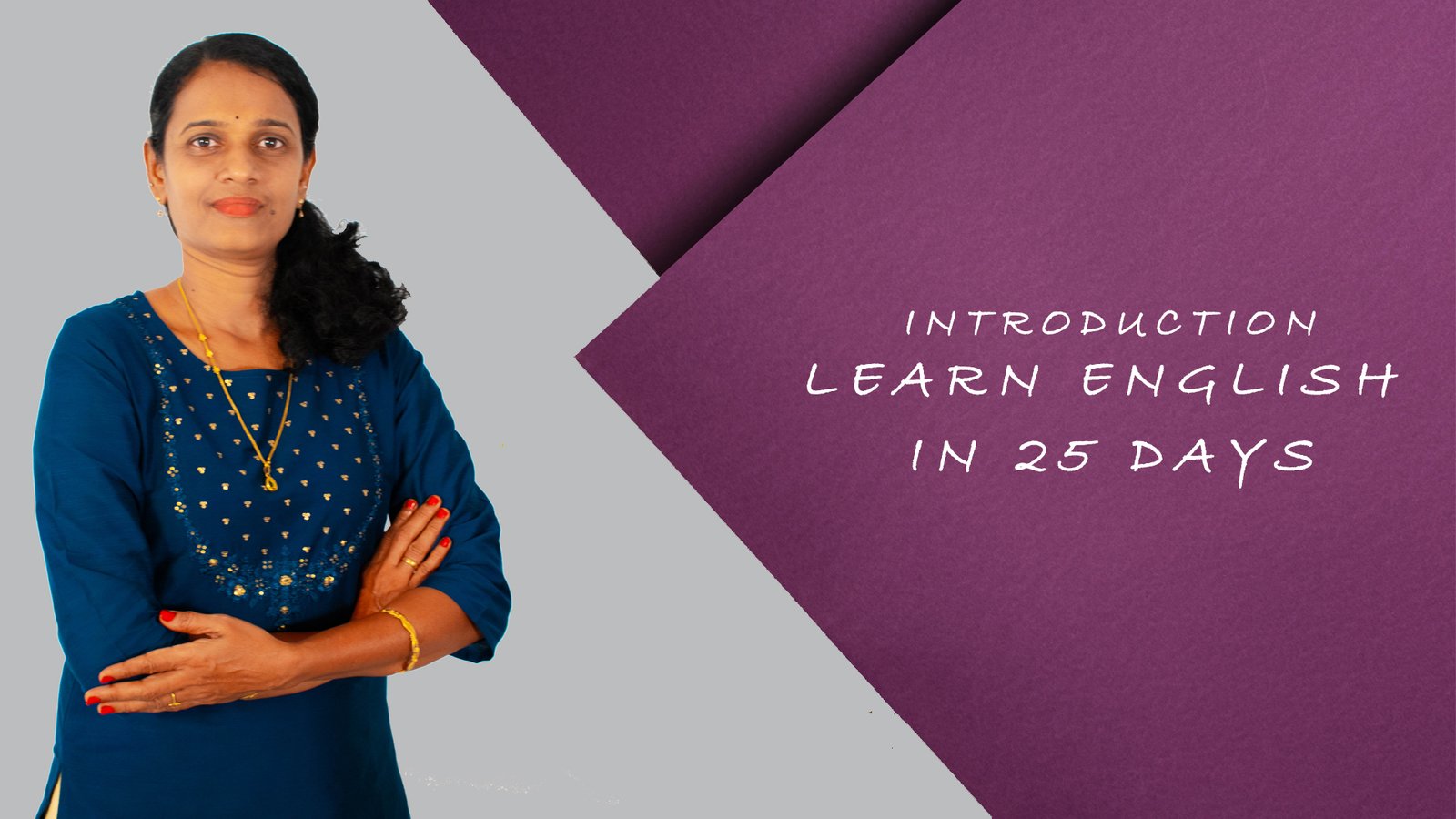
This course agenda is teaching English in 25 days. All basic things featured in day 1- day 25.
You will start communicating with others in English.
In this video you will learn about the introduction of 25 days program.
In this video you will learn about Alphabets & Letters
In this video you will learn about five major kinds of sentences.
Day 3 - In this video you will be learning about parts of speech - Noun and kinds of Nouns.
A pronoun is a word used in place of a noun or a noun phrase. They prevent repetitive phrasing—instead of saying "Sarah called Sarah's brother because Sarah needed help," we say "Sarah called her brother because she needed help."
An adjective is a word that modifies or describes a noun or pronoun. Adjectives give extra detail about size, color, shape, quantity, quality, or origin—answering questions like Which one?, What kind?, or How many? Without adjectives: "The dog barked at the cat." With adjectives: "The tiny, spotted dog barked at the scared cat."
An adjective is a modifying word that gives more information about a noun or pronoun—such as its size, color, quality, or quantity. When we want to compare the intensity or degree of these qualities across different nouns, we change the adjective's form using Degrees of Comparison.
A preposition is a word used to connect nouns, pronouns, or phrases to other words within a sentence. They show relationships of place, time, direction, or spatial position—answering questions like Where?, When?, or In which direction? Without prepositions: "The book is the table." With prepositions: "The book is on the table" or "The book is under the table."
A conjunction is a word used to connect words, phrases, or clauses together. They act as sentence connectors, creating logical relationships between different parts of a sentence.
A verb is a word that expresses an action, state of being, or occurrence. This lesson covers: Transitive & Intransitive Verbs: Verbs that require a direct object vs. those that do not. Main Verbs & Helping (Auxiliary) Verbs: Action words vs. verbs that assist in forming tenses. Action vs. Stative Verbs: Physical actions vs. mental/emotional states.
Explains how verbs change based on the person and quantity of the subject: Person: First Person (I/We), Second Person (You), and Third Person (He/She/It/They). Number: Singular (one) and Plural (more than one). Subject-Verb Agreement: Rules for matching singular subjects with singular verbs and plural subjects with plural verbs.
Mastering the three fundamental forms of verbs ($V_1, V_2, V_3$):Present ($V_1$): Base form used for current/habitual actions (e.g., go, eat, write).Past ($V_2$): Form used for completed past actions (e.g., went, ate, wrote).Past Participle ($V_3$): Form used in perfect tenses and passive voice (e.g., gone, eaten, written).
The process of changing a verb's form to indicate tense, person, number, and mood:Regular Verbs: Form their past tense by adding "-ed" or "-d" (e.g., walk $\rightarrow$ walked $\rightarrow$ walked).Irregular Verbs: Change completely without following fixed rules (e.g., sing $\rightarrow$ sang $\rightarrow$ sung).
Simple Present: Used for daily routines, habits, and general/universal truths. Simple Past: Used for actions completed at a specific time in the past. Simple Future: Used for actions that will happen in the future using will / shall.
Focuses on ongoing actions across time frames: Present Continuous: Actions happening right now (is/am/are + verb+ing). Past Continuous: Actions that were ongoing at a specific moment in the past (was/were + verb+ing). Future Continuous: Actions that will be ongoing at a specific time in the future (will be + verb+ing).
Describes completed actions related to another point in time:Present Perfect: Actions completed recently or past actions with a connection to the present (has/have + $V_3$).Past Perfect: An action completed before another past action occurred (had + $V_3$).Future Perfect: An action that will be completed before a specific point in the future (will have + $V_3$).
Emphasizes the duration of an action that started in the past and continues: Present Perfect Continuous: Actions that started in the past and are still continuing now (has/have been + verb+ing). Past Perfect Continuous: Actions that continued up to a certain point in the past (had been + verb+ing). Future Perfect Continuous: Actions that will continue up to a specific point in the future (will have been + verb+ing).
A comprehensive review and revision session covering all 12 tenses. Features practice exercises, sentence transformation tasks, and common error corrections to solidify overall tense usage.
Short questions added to the end of a statement to seek agreement or confirmation: Positive Statement → Negative Tag: ("You are a student, aren't you?") Negative Statement → Positive Tag: ("She cannot drive, can she?") Rules on selecting appropriate auxiliary verbs and pronouns for accurate tags.
Learn how to form accurate and natural English questions across different structures: Wh- Questions: Asking for specific information using who, what, where, when, why, which, and how. Yes/No Questions: Questions starting with auxiliary/helping verbs (is, are, do, does, did, have, can, etc.). Word Order Rules: Applying the standard question structure: Auxiliary Verb + Subject + Main Verb.
Enhance fluency and expressiveness through figurative language:Idioms: Expressions whose meanings cannot be understood literally from individual words (e.g., "break a leg" $\rightarrow$ good luck).Phrasal Verbs & Fixed Expressions: Common multi-word combinations frequently used in natural, everyday conversation.Practical Usage: How to integrate popular idioms correctly into spoken and written English.
Master the art of reporting what someone else said (Reported Speech):Direct Speech: Quoting someone's exact words within speech marks (e.g., He said, "I am going.").Indirect Speech: Reporting the message without exact words (e.g., He said that he was going.).Key Transformation Rules: Shifts in tenses, pronouns, time markers (e.g., today $\rightarrow$ that day), and reporting verbs (said $\rightarrow$ told/asked).
Understand the rules governing the use of determiners before nouns: Indefinite Articles (A / An): Used with singular countable nouns when referring to general items ("an apple", "a car"). Sound-based usage rules (vowels vs. consonants). Definite Article (The): Used when referring to specific nouns, unique items, or things already mentioned ("the sun", "the book on the table"). Zero Article: Instances where no article is needed (uncountable nouns, general plurals, proper names, etc.).
Improve spoken clarity and sound natural by mastering key pronunciation principles: Silent Letters: Identifying words with unpronounced sounds (e.g., knife, doubt, receipt). Word Stress & Syllables: Placing emphasis on the correct syllable in multi-syllable words. Commonly Mispronounced Words: Correcting everyday pronunciation mistakes in English vocabulary.
The grand finale and review session wrapping up the entire 25-day course: Comprehensive Review: Summarizing core concepts from tenses, grammar rules, speech types, and vocabulary. Practical Exercises: Mixed quiz questions, sentence correction challenges, and fill-in-the-blanks. Self-Assessment: Testing overall progress and building confidence for fluent English communication.
Learn English in 25 days
No Review found